
How to Read a Battery Test Summary? A Complete Step by Step Guide
In the world of battery certification, the Test Summary (TS) is the equivalent of a passport for dangerous goods. Since 2020, it has been mandatory for every lithium cell and battery, and in 2026, it forms the foundation of the technical documentation required by the new EU Regulation.
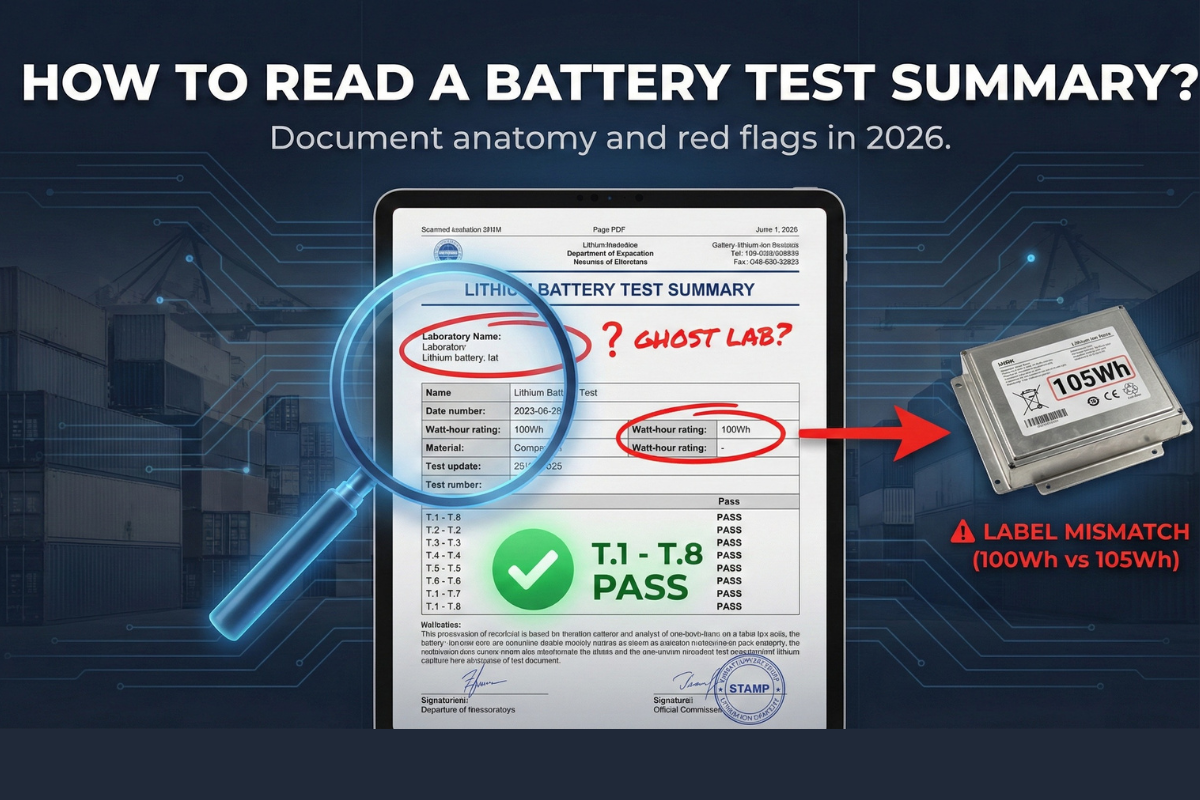
In the world of battery certification, the Test Summary (TS) document is the equivalent of a passport for dangerous goods. Since 2020, it has been mandatory for every lithium cell and battery, and in 2026, it forms the foundation of the technical documentation required by the new EU Regulation.
Despite this, many companies still make mistakes during its verification. In this article, we will guide you through the anatomy of a compliant Test Summary and highlight the "red flags" you need to watch out for.
What exactly is a Test Summary?
According to sub-section 38.3.5 of the UN Manual of Tests and Criteria, manufacturers and distributors of cells or batteries must make a summary of test results available. This document has replaced extensive and often confidential test reports, extracting the key data needed by freight forwarders, insurers, and control authorities.
A Test Summary is not a "forever" certificate. Any significant change to the battery design (more than 0.1 g of lithium or 20% capacity) requires re-testing and an updated TS.
Test Summary: 10 Mandatory Points
Every compliant Test Summary must include 10 specific elements. If even one is missing, the document may be challenged during a roadside inspection (ADR) or customs clearance.
Manufacturer information: Full name, address, telephone number, email, and website.
Laboratory information: Details of the entity that performed the UN 38.3 tests.
Unique test report ID: An identifier that allows the TS to be linked to the full test report.
Date of the test report: Must be current relative to the version of the battery tested.
Product description: Is it a cell or a battery? Lithium-ion or lithium-metal?
Battery mass: Stated in kilograms (kg).
Electrical parameters: Watt-hour rating (Wh) for Li-ion or lithium content in grams (g) for Li-metal.
Physical description: A brief characterization (e.g., "battery pack in aluminum casing").
Confirmation of test results: A list of conducted tests from T.1 to T.8 along with a positive result (Pass).
Signature: Name, surname, and title of the responsible person in the company.
What exactly do UN 38.3 tests check?
In Item 9 of every Test Summary, you will find information regarding the successful completion of a test series, ranging from altitude simulation and vibration to external short circuit and overcharge.
For a detailed description of each of these tests (from T.1 to T.8) and an explanation of why they are crucial for transport safety, please refer to our previous article: 👉 Transport of Lithium Batteries – A Compendium of Knowledge on UN 38.3
What to watch out for when reviewing a Test Summary?
As a testing entity, we most frequently encounter the following issues in supplier documentation:
Inconsistency with the label: If the battery label states 105 Wh, but the Test Summary lists 100 Wh – the document is invalid.
Outdated UN Manual version: In 2026, documents should refer to the latest amendments (Revision 7 or 8). Older versions may not account for new safety requirements.
"Ghost" Laboratory: It is crucial to verify whether the laboratory listed in the TS possesses the appropriate technical competencies. Documents from non-existent or unverified facilities remain a significant market issue.
Proper verification of the Test Summary is the first line of defense against legal issues and warehouse fires. If you have doubts about whether a document from your supplier is authentic or meets the requirements of the latest ISO standards, do not take the risk.
DLP Compliance Services offers professional documentation verification and auditing. We will check whether your battery is safe and ready for the EU market in accordance with the latest guidelines.
Copyright © 2025 DLP Sp. z o.o.