
Lithium Battery Transport: The UN 38.3 Compendium
Legal Requirements, Testing, and Supply Chain Responsibility
In global logistics, lithium-ion batteries are not treated as ordinary cargo. They are classified as Class 9 Dangerous Goods. Why does this matter for your business? Because a single documentation error canfreeze your supply chain, exclude you from the market, or expose you to massive financial penalties.
The foundation of transport safety, whether by land, sea, or air, is the UN 38.3 standard. This is not a voluntary quality certificate; it is a strict legal requirement. Without it, the legal movement of thesecomponents through the supply chain is impossible.
1. What is UN 38.3 and Why Must You Know It?
UN 38.3 refers to section 38.3 of the UN Manual of Tests and Criteria. While the manual itself is a set of recommendations, it becomes binding law the moment your shipment enters the transport network.
What does this mean in legal practice? These requirements are implemented through specific international modal regulations that you, as the shipper, must respect:
Road Transport (ADR): In Europe, the requirement is written directly into the special provisions for Class 9.
Air Transport (IATA DGR / ICAO TI): These are the most restrictive regulations. Errors here can lead to immediate grounding of cargo.
Sea Transport (IMDG Code): Essential for container imports, especially from Asia.
If your battery is not UN 38.3 certified, you cannot legally ship it. Every courier or freight forwarder has the right, and the obligation, to refuse cargo that does not meet these standards.
2. Who Does This Apply To?
Many companies fall into the trap of thinking: "I don't manufacture batteries, so UN 38.3 doesn't concern me." This is a mistake. The requirement applies to every lithium cell and battery, regardless of its size orpurpose.
Testing is mandatory for:
Standalone cells and battery packs (e.g., spare parts).
Batteries contained in equipment (laptops, e-bikes, medical devices, IoT sensors).
Batteries packed with equipment (in the same box but not installed).
Even if you use certified cells from a reputable supplier, your newly designed battery pack must undergo its own series of tests. You cannot simply "inherit" the certification from the cell level to the final product.
3. The Anatomy of Testing. What is Being Checked?
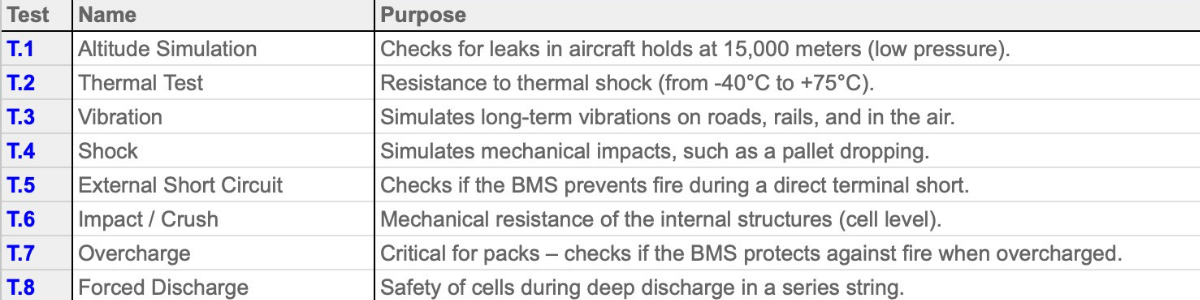
The UN 38.3 procedure consists of eight rigorous tests (T.1 - T.8) simulating the extreme conditions that can occur during global transport:
4. Legal Traps. The "Test Summary" Obligation
One of the most important recent changes is the Test Summary requirement.
As an importer or distributor, you must possess this standardized document and provide it upon request to carriers, customs, or transport inspectors. While the full laboratory report is confidential, the Test Summary is your "passport" that must be available throughout the supply chain.
Before you pay a supplier for goods, demand the Test Summary. If they hesitate to provide it, the tests likely were never performed, and you will not be able to legally move the goods into the EU or US.
5. Liability and Penalties. Why You Can’t Risk It
Under international law, an importer bringing products under their own brand is treated as the manufacturer, assuming full legal liability.
Logistical Blockades: Major carriers (DHL, FedEx, Maersk) routinely demand the Test Summary before accepting a booking.
Administrative Fines: Transport authorities can impose heavy fines for shipping dangerous goods without the required testing or correct marking.
Insurance & Civil Liability: In the event of a fire during transport or in a warehouse, the insurer will almost certainly deny the claim if the goods lacked UN 38.3 certification. You will then be liable for allemergency response costs and material damages.
UN 38.3 is not an optional extra. It is the fundamental, global passport for every lithium battery. For any professional importer or manufacturer, verifying this standard is the first step of due diligence. Without a positive test result, there is no legal transport, and therefore, no legal or safe business.
Copyright © 2025 DLP Sp. z o.o.