Product success begins with compliance. The significance of the IEC 63000 standard in the manufacturing process.
Every day, we come into contact with dozens of electrical devices. From the smartphone we start our day with, through the coffee machine and laptop, to the baby monitor watching over our sleeping child. Looking at their modern designs and sleek enclosures, we rarely stop to consider what lies hidden inside.
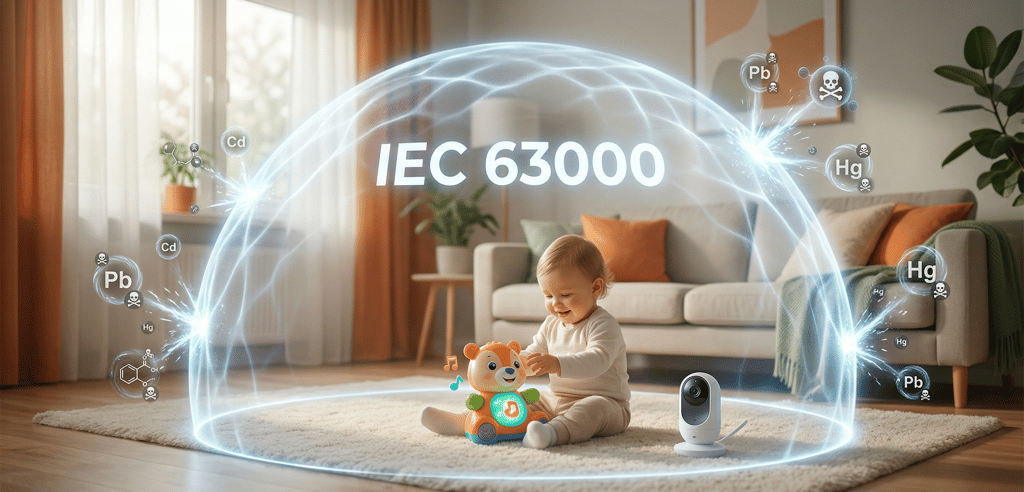
The reality, however, is that electronic equipment is not just copper, silicon, and plastic. It also involves complex materials chemistry. Without proper oversight, manufacturing processes could introduce highly toxic elements into our homes. A rigorous system of testing, certification, and supply chain verification ensures that our devices are safe and do not release hazardous substances into the environment. Its foundation, acting as an "invisible shield" for consumers, is the international IEC 63000 standard.
What is the IEC 63000 standard, and what exactly does it cover?
Although the full name of this standard "Technical documentation for the assessment of electrical and electronic products with respect to the restriction of hazardous substances", sounds highly technical and bureaucratic, its market role cannot be overstated.
The IEC 63000 standard (implemented in Europe as EN IEC 63000) is a global framework that precisely defines how a manufacturer must prove that their product is safe for the user.
Proof of product innocence. Manufacturing a toxin-free device is one thing, but proving it to market surveillance authorities is another. The standard imposes an obligation on manufacturers to gather solid evidence. In practice, this means the necessity of collecting detailed declarations from suppliers of the smallest components (from resistors to enclosure screws), material certificates, and hard laboratory test results.
A risk-based approach. The IEC 63000 standard successfully replaced the older EN 50581 standard, introducing a much more modern and pragmatic approach. It does not require blind and costly testing of every, even the least significant, component in a chemical laboratory. Instead, it compels engineers and compliance specialists to conduct a risk assessment. Wherever the probability of using a hazardous substance (e.g., lead in solder joints) is high, rigorous testing is required.
Verification of the entire supply chain. This standard makes experts and consumers aware of one crucial fact: the safety of the final product depends on the safety of its weakest link. From the perspective of IEC 63000, it does not matter whether we are talking about a complex integrated circuit or ordinary enclosure plastic; each of these components must have appropriate documentation confirming its chemical purity.
Why does the IEC 63000 standard not exist without the RoHS Directive?
To fully understand the weight of the IEC 63000 standard, we must look at the regulations for which it was created. After all, technical documentation is not created in a vacuum. In this case, its foundation and legal reference point is the EU RoHS (Restriction of Hazardous Substances) Directive, which restricts the use of certain hazardous substances in electrical and electronic equipment.
The relationship between the two is best described through a clear division of roles:
RoHS is the restrictive law (the "what is prohibited" requirement). This directive establishes a strict boundary. It lists specific chemicals and heavy metals, such as lead, mercury, cadmium, hexavalent chromium, or toxic phthalates and flame retardants, whose content in any homogeneous material within the electronics cannot exceed rigorous limits (typically just 0.1% or 0.01% by weight).
IEC 63000 is the evidentiary tool (the answer to the question "how to prove it?"). A manufacturer cannot simply make a verbal declaration: "my equipment is safe." The regulations require hard, documented facts. This is exactly where the IEC 63000 standard comes into play, instructing engineers on how to systematically build the technical documentation (the so-called Technical Construction File), which serves as irrefutable proof of compliance with RoHS requirements.
Legal and safe importation of equipment from outside the EU.
This interconnection between the RoHS Directive and the IEC 63000 standard takes on special significance when we look at today's market, which is dominated by electronics manufactured outside the European Union (primarily in Asia). EU law is uncompromising in this regard: if you import equipment from outside the EU under your own brand or act as its first importer, you assume the full legal responsibility of the manufacturer.
To legally and safely introduce such a product to the market, relying solely on trust in a foreign supplier is insufficient. The importer must physically possess technical documentation compiled in accordance with IEC 63000 guidelines. This entails verifying certificates and test results from Asian factories against European standards. The absence of such measures and releasing equipment onto the market "blindly" not only poses the risk of severe financial penalties from market surveillance authorities but, above all, directly exposes consumers to untested, toxic materials. This system operates as a fine sieve, designed to intercept hazardous products at the Union's borders.
Exceptions to the rule: what RoHS and IEC 63000 do not apply to.
For a complete picture, it is worth noting that the legislation provides for certain narrow exceptions. The restrictions of the RoHS Directive (and consequently, the obligation to compile documentation in accordance with IEC 63000) do not apply to, among others:
Equipment designed exclusively for military purposes and national defense.
Equipment designed to be sent into space.
Large-scale stationary industrial tools (e.g., massive, custom-built production lines operating within enclosed factories).
This is due to the fact that such equipment operates in specific, controlled environments, frequently demands absolute reliability based on legacy technologies, and does not directly reach ordinary consumers.
Your health comes first: what this means for you as a consumer.
For the average user, standard numbers and EU directives might seem like a bureaucratic abstraction. So why should we, as consumers, even bother with IEC 63000-compliant documentation? The answer is incredibly simple, though often overlooked in the daily rush: it is about our health and the safety of our children.
When we buy a new device, we assume upfront that it is safe. We rarely consider that electronic equipment is an advanced chemical puzzle. How then, without being an engineer or a laboratory worker, can we ensure that what we bring into our homes is not a toxic hazard?
Here are a few important points to look out for before making a purchase.
Although as customers we do not have access to the multi-page IEC 63000 technical documentation, regulations force manufacturers to place clear signals on products and packaging. When picking up a box with a new smartphone, baby monitor, or coffee machine, pay attention to these key elements:
The presence and correctness of the CE mark: This is the absolute foundation. The CE mark (which we will examine more closely in a moment) is the manufacturer's legal promise that the equipment has been tested and meets the requirements of the RoHS Directive. Important: pay attention to the proportions of the mark, as fraudsters often use a deceptively similar "China Export" mark. The genuine European CE mark has specific letter spacing (the letters fit into two intersecting circles).
Additional "RoHS Compliant" markings: Legally, the CE mark itself already confirms the absence of hazardous substances (such as lead or cadmium). However, many conscious and responsible manufacturers place an additional logo on the packaging; often, this is a green leaf, a check mark, or simply the word "RoHS". This is a clear signal to you that the company cares about the chemical safety of its products and wants to highlight it.
The crossed-out wheeled bin symbol: This is the marking of the WEEE Directive (concerning electronic waste). It is inextricably linked with RoHS. It informs you that the equipment, due to its complex interior components, requires specialized recycling at the end of its life and cannot be disposed of in a standard waste bin.
Full details of the manufacturer and the EU importer: This is the most crucial credibility test, especially in the era of cheap purchases from Asian e-commerce platforms. A safe product, compliant with EU law, must feature the clearly printed name, registered trademark, and exact postal address of the manufacturer on the packaging or enclosure. If the equipment was manufactured outside the EU, the physical address of the European importer must be present.
Missing information is a red flag. If the packaging of an inexpensive electronic toy lacks the manufacturer's address, and the brand name is just a random string of letters, refrain from purchasing it. It is precisely these "anonymous" products that most often completely bypass the requirements of the IEC 63000 standard, exposing your child to contact with lead in solders or toxic phthalates in plastics.
By choosing equipment that is transparently and properly labeled, you are voting with your wallet for safety and cutting off the lifeblood of dishonest suppliers who risk your health to cut costs.
The CE Mark and the EU Declaration of Conformity
Almost everyone is probably familiar with the CE mark (from French: Conformité Européenne). We see it every day on chargers, televisions, toys, or household appliances. Unfortunately, in the minds of many consumers, and sometimes even novice importers, it functions as an ordinary, meaningless sticker. The truth, however, is completely different.
The CE mark is not a graphic accessory; it is a legal promise. When a manufacturer or authorized importer affixes the CE mark to their product, they make a legally binding declaration: "My product has been designed, manufactured, and tested in accordance with all the rigorous European Union directives that apply to it." In the case of electronics, one of the absolutely most important ones is precisely the RoHS Directive, which protects us from hazardous substances.
No IEC 63000 = No CE mark. So, how do regulations and standards merge into one coherent whole?
It is an interconnected system:
To allow the CE mark to appear on a product, the entity placing the equipment on the market must issue an official document called the EU Declaration of Conformity (DoC). This is a kind of "passport" for the device.
However, to be able to legally sign such a declaration, they must possess the so called technical documentation.
To demonstrate compliance with the RoHS Directive, this technical documentation must be compiled strictly according to the guidelines of the IEC 63000 standard.
Without gathering evidence in the form of tests, material certificates from suppliers, and risk assessments, issuing an EU Declaration of Conformity is simply making a false statement.
Origin does not matter; safety in the EU does. At this point, it is worth emphasizing a key principle of the European market's operation. Legally, it makes not the slightest difference in which country in the world the factory that produced the equipment is located. Whether it is local production in Europe or mass import from Asian or American markets, the rules of the game are identical. Every electronic and electrical product introduced to the European Union market must be fully and unconditionally safe for the end customer.
Market surveillance authorities (in Poland, including UOKiK or the Trade Inspectorate) verify this with equal strictness for all entities. They have the right at any time to request the full technical documentation, take samples from a store, and send them to an independent laboratory.
If it turns out that in the tested charger or toy, regardless of where it was imported from, the solder joints are full of toxic lead, and the responsible company does not have a documentation file compliant with IEC 63000, the consequences are ruthless. The product is immediately withdrawn from the market, massive financial penalties are imposed, and in extreme cases, a mandatory recall and buy-back of the defective goods from consumers is ordered.
Therefore, from the perspective of a conscious customer and a responsible entrepreneur, the CE mark supported by a solid Declaration of Conformity is confirmation that, regardless of the geographical latitude of production, tremendous research effort was invested to ensure the equipment in our homes is 100% chemically safe.
Let's read electronics labels just like food labels
When we read about EU directives, standards like IEC 63000, or complex conformity assessment procedures, it is easy to get the impression that we are dealing solely with official bureaucracy. However, behind every legal requirement, certificate, and rigorous laboratory test lies one overriding goal: the protection of human health and the natural environment.
For years, we have been building tremendous awareness regarding healthy nutrition. We have become sensitive to artificial dyes or harmful preservatives, and reading food labels has become a habit because we understand that what we eat affects our bodies. It is high time we began verifying electrical and electronic products of everyday use with the exact same attention.
After all, smartphones, laptops, household appliances for food preparation, or interactive toys accompany us and our children around the clock. They frequently have direct contact with our bodies and the environment in which we breathe. The absence of toxic lead, cadmium, or harmful phthalates inside them is just as important as the absence of harmful chemicals in our food.
Whether we are talking about rigorous safety testing of cells and batteries, or chemical tests for compliance with the RoHS Directive, the common denominator is always an investment in safety. For responsible manufacturers and importers, meeting the requirements of the IEC 63000 standard is the foundation of ethical business. For us, in turn, it is a clear guideline while shopping.
Let us remember that an informed consumer is a healthy consumer. By paying attention to correct labeling, the presence of the CE mark, and the manufacturer's transparency, we can be certain that the technology facilitating our lives does not pose a hidden threat to our family. If you are a manufacturer or importer, the experts at DLP Sp. z o.o. will help you compile the documentation and adapt your product to EU requirements. We solve testing and compliance issues for you, guaranteeing the legal and safe introduction of your equipment to the market.
Copyright © 2025 DLP Sp. z o.o.