
It Is Not Just the Battery That Must Be Safe: A Comprehensive Guide to Packaging for the Transport of Dangerous Goods (DG)
Most manufacturers and importers focus on tests of the battery itself, such as UN 38.3. While this is the correct approach, it constitutes only half of the logistical success. It is not uncommon for a perfectly tested battery to be detained at an airport or by a freight forwarder. The reason is trivial: it was packed in a manner inconsistent with the certification.
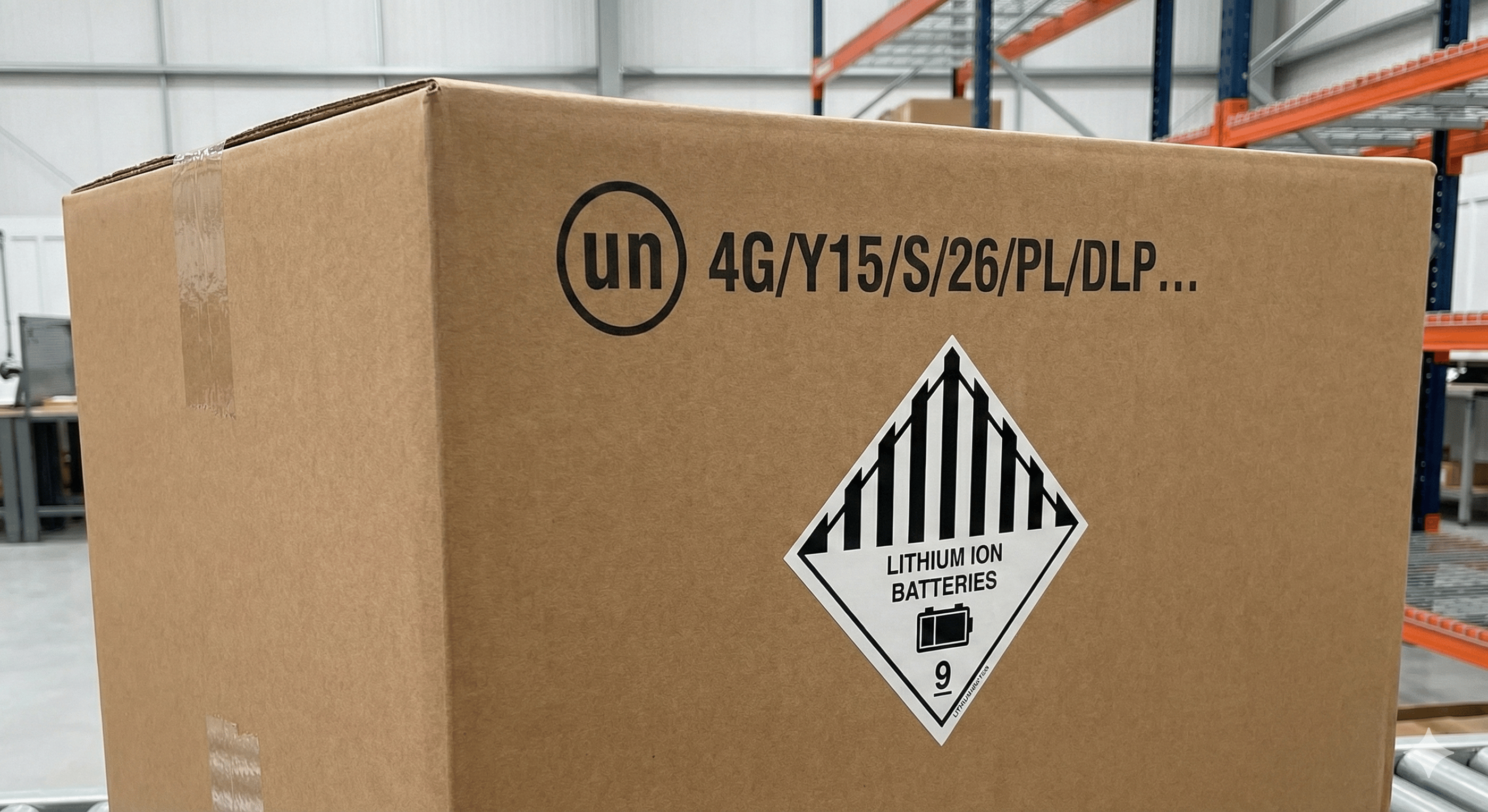
Lithium batteries fall under Class 9 of Dangerous Goods. This means they are subject to strict regulations. Depending on their size and power, they must be transported either in UN - certified packaging or in reinforced cartons meeting specific regulatory exemption requirements.
Below, we present a comprehensive guide to DG packaging, ranging from small cells to Energy Storage Systems, as well as the regulations governing their transport by land, sea, and air.
WHAT IS THE UN CODE ON PACKAGING AND HOW TO READ IT?
For the transport of large (fully regulated) batteries or for air freight, the packaging must be certified. This is confirmed by a printed string of characters, which provides the transport inspector with precise information regarding the packaging’s durability.
Code Example: 4G/Y15/S/26/PL/DLP...
What the Individual Sections Represent:
UN Symbol – Indicates that the packaging has undergone rigorous testing at an accredited research institute in accordance with UN standards.
4G – Packaging Type. The digit 4 denotes a box or crate, and the letter G indicates the material—in this case, fiberboard (corrugated cardboard).
Y – Packing Group. A key parameter defining the durability level of the packaging. Although lithium batteries belong to Hazard Class 9—for which UN Model Regulations theoretically do not assign Packing Groups—packing instructions (e.g., IATA PI 965) mandatorily require the use of packaging meeting the Level II performance standard.
X (Packing Group I): For high-danger goods (e.g., cyanides).
Y (Packing Group II): For medium-danger goods. This is the standard required for lithium batteries. It signifies that the carton has successfully passed drop tests from a height of 1.2 meters, ensuring safety under typical logistical conditions.
Z (Packing Group III): For low-danger goods.
15 – The maximum gross weight in kilograms allowed for the packed shipment. Exceeding this weight results in the voiding of the certification.
S – Indicates that the packaging is intended for solids or contains inner packaging (e.g., batteries wrapped in foil).
26 – The year of manufacture of the packaging.
THE SPECIFICS OF AIR TRANSPORT (IATA DGR) – KEY REQUIREMENTS.
Air transport regulations are the most restrictive and are subject to continuous tightening (including the elimination of Section II for loose batteries). The procedure depends strictly on the method of packing and classification:
1. Batteries Shipped Loose (UN 3480) – Packing Instruction PI 965 states that shipping standalone batteries as standard air freight or mail is not possible. Currently, even small batteries (under 100 Wh) must be shipped in accordance with the rigorous Section IB.
Packaging Requirements: Unlike land transport regulations, in air transport (Section IB), the outer packaging must possess a UN certificate (UN Specification Packaging). It must meet the requirements of at least Packing Group II (marked Y or X in the UN code, e.g., 4G/Y...). The use of exclusively "Strong Rigid Packaging" without UN certification is not permitted for this section.
Labeling and Documentation: The following are required on the package:
Class 9A Hazard Label (Lithium Battery Label).
Lithium Battery Mark.
"Cargo Aircraft Only" (CAO) Label – prohibiting loading onto passenger aircraft.
For Section IB, it is mandatory to prepare a full Shipper's Declaration for Dangerous Goods (DGD), in which the type and certification of the packaging used must be indicated.
Limit: A maximum of 10 kg net weight of batteries per package.
Important Note for Power Banks: In air transport, power banks are classified as loose batteries (UN 3480), not as batteries contained in equipment. This entails an absolute ban on transporting such commercial shipments (Cargo) in the hold of passenger aircraft. They may fly exclusively on cargo aircraft (Freighters) while adhering to the strict packing requirements mentioned above.
2. Batteries Packed with Equipment (UN 3481) – Packing Instructions PI 966/967. Here, Section IIstill applies, allowing for the greatest facilitation, provided the batteries are shipped in the same carton as the device (but not inserted into it) or are installed within the device.
Limit: The maximum net weight of batteries per package is 5 kg.
THE DIFFERENCE BETWEEN ADR AND IATA.
In road (ADR) and sea (IMDG) transport, complying with the conditions of Special Provision 188 (SP 188) for batteries up to 100 Wh exempts shipments from most restrictions. UN - certified packaging is not required; strong rigid packaging combined with the Lithium Battery Mark is sufficient.
In contrast, in air transport (IATA), even these same small batteries shipped loose require specialized labeling and full DGD documentation (Section IB), which often precludes the use of standard courier services.
SIZE MATTERS - WHEN TO USE A CARTON AND WHEN A CRATE?
The selection of packaging depends directly on the weight and dimensions of the battery. In battery logistics, two main standards are distinguished:
Fiberboard Boxes (Code 4G): Used for batteries whose weight allows for safe handling in fiberboard, typically up to 30–40 kg. Above this mass, the fiberboard may not withstand the point pressure exerted by a heavy battery during transport vibrations.
Wooden and Plywood Boxes (Codes 4C and 4D): For heavy loads (such as EV batteries), crates are employed.
Code 4C: Natural wood boxes.
Code 4D: Plywood boxes. These are highly popular in export because, unlike solid wood, they do not require phytosanitary fumigation (heat treatment against pests).
WHY A STANDARD CARTON IS NOT ENOUGH? TESTING PROCEDURES.
To obtain a UN code (essential for batteries exceeding 100 Wh), packaging must undergo a series of laboratory tests simulating the worst-case transport scenarios.
Drop Test: For Packing Group II (designated 'Y'), the fully loaded box is dropped from a height of 1.2 meters. It must land on its corner, among other orientations. The passing criterion is that the packaging must not rupture, and the contents must not be released.
Stacking Test: This test verifies whether the bottom carton will collapse under the weight of other packages stacked upon it on a pallet. It simulates the pressure exerted during storage in a warehouse or container for 24 hours with a stack height of 3 meters.
Cobb Test: Examines the resistance of the carton's outer layer to water absorption. This is crucial in sea transport, where high humidity could compromise the carton's structural integrity.
MOST COMMON MISTAKES IN BATTERY PACKAGING.
Even the best certified packaging is of no use if errors are committed inside the package.
Misinterpretation of Exemptions: The belief that a small battery can be shipped in a soft bubble mailer. This is prohibited. The requirement for Strong Rigid Packaging applies at all times.
The 'Rattle Effect': The battery must not shift inside the box. It must be immobilized using non-combustible filleror special inserts.
Lack of Terminal Isolation: Terminals must be protected against short circuits (using insulating tape, caps, or individual bags).
Obscured Labels: Warning stickers and marks must always be visible on the side panel; they cannot be folded over edges.
The transport of dangerous goods is an interconnected system. A safe battery must be placed in the appropriate packaging. At DLP, we help identify whether your battery falls within exemption limits or requires full UN packaging, and we select the appropriate logistical solution.
Copyright © 2025 DLP Sp. z o.o.