
Guide to the IEC 62619 Standard
Safety requirements for lithium-ion batteries in industrial applications. This is a key standard, particularly for large-scale and residential energy storage systems BESS/ESS, uninterruptible power supplies UPS, and backup power systems for telecommunications infrastructure.
We live in an era of energy transformation, where the global demand for electricity is growing at an unprecedented rate. Along with the dynamic development of renewable energy sources, such as wind and photovoltaic farms, a fundamental problem with grid balancing has emerged due to the instability of these sources.
An excellent and still very fresh proof of how fragile modern infrastructure can be is the massive blackout on the Iberian Peninsula from April of last year (2025). The cascading disconnection of just a few gigawatts of power and voltage fluctuations in the grid led to a complete collapse of the system, depriving tens of millions of residents in Spain and Portugal of electricity for many hours. Paralyzed transport, hospitals running on generators, cut-off telecommunications, this event clearly proved that energy security is not just an empty political slogan.
Large-scale Energy Storage Systems (ESS) have become the answer to this instability and the guarantor of grid security.
Today, energy storage facilities have ceased to be an innovation and have become absolutely crucial critical infrastructure. They ensure the continuity of power supply, instantly stabilize grid frequency, and save systems from collapse in fractions of a second. This market is growing rapidly, and tech giants such as CATL, BYD, Tesla with their Megapack systems, Sungrow, LG Energy Solution, and Fluence are responsible for the production of powerful battery storage systems today. The scale of installations has long ceased to be measured in megawatt-hours; today, volumes are reaching tens of gigawatt-hours.
What is the IEC 62619 standard?
In the face of such a massive scale of deployments, it became necessary to standardize and drastically tighten safety standards. This is where the IEC 62619 standard enters the stage.
Simply put, it is an international standard specifying rigorous requirements and test procedures for lithium batteries (both individual cells and entire battery systems) intended for industrial applications. Certification according to this standard is a market pass and hard proof that a given battery or energy storage system has been designed to minimize the risk of failure, even in extremely demanding conditions.
Why are there no shortcuts when it comes to safety?
Lithium-ion batteries are characterized by immense energy density. In the production and certification of critical infrastructure equipment, there is no room for financial compromises or technological shortcuts. Allowing devices that do not meet rigorous requirements onto the market carries disastrous risks.
The Thermal Runaway phenomenon: This is the worst-case failure scenario. A short circuit in one defective cell leads to a sudden, uncontrolled temperature rise, a fire, and a chain reaction, propagation, that instantly engulfs subsequent modules.
The scale of fires and destruction: We all remember the high-profile fires on transport ships, such as the Fremantle Highway or Felicity Ace, where electric cars caught fire. The fire, fueled by burning lithium-ion batteries, was virtually impossible to extinguish for days, destroying thousands of vehicles and generating hundreds of millions of dollars in losses. Now imagine an energy storage facility. A single ESS container is the densely packed battery capacity equivalent of dozens of electric cars. When a fire breaks out in a large-scale storage facility, as happened at the Victoria Big Battery in Australia (where a thirteen-ton module burned down) or at facilities in California and South Korea, the scale of destruction is almost apocalyptic. Dozens of fire brigade units battle the elements, and extinguishing it, or more often, controlled burning, takes many days.
Emission of highly toxic gases: The burning of thousands of lithium-ion cells is accompanied by the release of massive amounts of deadly chemicals (including carcinogenic and corrosive substances, like hydrogen fluoride), which forces the evacuation of local residents and poses a huge threat to the environment for years.
It is precisely for these reasons that the IEC 62619 standard is so restrictive. It forces systems to be designed in such a way that a potential ignition of one cell cannot spread to the entire container (propagation tests). Releasing an ESS onto the market without these safeguards is literally planting a ticking time bomb under our infrastructure.
For which sectors and products is the IEC 62619 standard required?
Although the title of the IEC 62619 standard includes the phrase "industrial applications," it actually covers devices whose effects we rely on every day. The scope of this standard is divided into two main categories: stationary applications and mobile (traction) applications.
Stationary applications – the silent guardians of our everyday lives
This group includes systems that, by design, do not change their location after installation. They are responsible for the continuous operation of our infrastructure:
ESS Energy Storage Systems: These are not only the gigantic, multi-container installations at wind farms mentioned earlier. They are also home energy storage systems that millions of people install in their garages to store electricity from photovoltaic panels. A refrigerator-sized battery in your home must meet the same rigorous fire safety standards as massive grid installations.
High-power UPS emergency power supplies: Have you ever wondered why, in the event of a sudden power outage across an entire neighborhood, hospital systems work without interruption, and you can still withdraw cash from an ATM or pay by card because bank servers are running? This is thanks to powerful, lithium-ion UPS systems.
Telecommunications infrastructure: When there is a power outage, your smartphone still has reception. This happens because every base transceiver station (BTS) is equipped with emergency battery systems that must operate reliably and safely in harsh outdoor weather conditions.
Mobile (traction) applications – driving the modern economy
Unlike passenger vehicles, this category includes powerful machines working in continuous cycles in factories, warehouses, or public transport:
Automated Guided Vehicles (AGVs) and warehouse robotics: When you order a package that reaches you the next day, there is a good chance that in a modern logistics center (e.g., Amazon or InPost), it was picked by autonomous robots and AGVs powered by industrial lithium-ion batteries.
Forklifts and transport machines: Electric forklifts that you see in every large DIY store, like Castorama or Leroy Merlin, have been massively switching in recent years from heavy lead-acid batteries to efficient lithium-ion packs certified precisely according to IEC 62619.
Public and heavy transport (Railway and Marine): Electric passenger ferries, hybrid trains, and even modern trams using batteries to travel without overhead lines in historic city centers.
What does IEC 62619 absolutely NOT apply to?
To avoid market confusion during the certification process, this standard sets a very clear boundary. IEC 62619 does not apply to:
Road vehicles (EV – Electric Vehicles): Your Tesla, electric Nissan Leaf, and even an electric city bus are subject to entirely different automotive regulations and standards (e.g., ISO 12405 series, UN ECE R100).
Consumer and portable electronics: Smartphones, laptops, power banks, cameras, or power tools are not industrial applications. For them, a different, "lighter" standard is crucial: IEC 62133.
Light private electromobility: Electric scooters and e-bikes also have their own dedicated safety assessment standards and are not considered under IEC 62619.
Traditional starter batteries: 12V batteries used exclusively to start internal combustion engines (even if they are made using lithium-ion technology).
Scope of testing under IEC 62619.
To imagine the kinds of tests devices undergo under the IEC 62619 standard, let's use an everyday example: a 10 kWh home energy storage system hanging on the wall in your garage, working with photovoltaic panels.
The standard divides testing into two rigorous stages. Tests at the single-cell level (from which the storage is built) and tests of the entire battery system (the finished device along with the BMS control electronics).
Here are the threats these tests are designed to protect you and your home from:
Stage 1: Single-cell level testing
Before a manufacturer assembles a large energy storage unit, a certified testing body evaluates the individual cylindrical or prismatic cells that will make up the device.
External short circuit:
The test: The positive and negative terminals of the cell are connected with virtually no resistance, forcing an immediate flow of massive current.
Goal: To check if the cell has appropriate internal fuses and does not explode in a fraction of a second.
Real-life example: Imagine a severe short circuit occurs during garage renovations on the cables leading to the storage, or rodents chew through the wires. The battery must survive this short circuit without starting a fire.
Impact / Drop test:
The test: A heavy steel weight is dropped on the cell, or the cell itself is dropped from a specific height onto a concrete floor.
Goal: To verify the mechanical resistance of the cell casing and ensure that deformation will not cause an internal short circuit.
Real-life example: Someone accidentally hits the storage casing with a heavy tool (e.g., a hammer or pipe), or the device undergoes shocks during transport to your home.
Thermal abuse test:
The test: The cell is placed in a thermal chamber and drastically heated (usually to 130°C) for a specified time.
Goal: To verify the chemical stability of the electrolyte at extremely high temperatures.
Real-life example: A fire breaks out in the garage from another source (e.g., a car's wiring catches fire). The cells in the energy storage cannot explode on their own due to outside heat and add fuel to the fire.
Overcharge / Forced discharge:
The test: Laboratory "pumping" of current into the cell well beyond its voltage specification, or draining energy from it below a safe level.
Goal: To check the chemical tolerance of the cell to charging errors.
Real-life example: A failure of a photovoltaic inverter, which malfunctions on a sunny day and tries to pump twice the allowed voltage into the battery.
Stage 2: Testing at the battery system and BMS level
Once individual cells pass the tests, the complete system is tested, meaning cells connected into modules, integrated with the intelligent brain of the battery: the BMS (Battery Management System). The reliability of the electronics and software is the heart of the IEC 62619 standard.
Overcharge / Overheating control by BMS:
The test: The laboratory intentionally simulates an external charger/inverter failure, supplying too much current or forcing the system into an overheating state.
Goal: To verify if the BMS will detect the anomaly and flawlessly, automatically cut off the physical circuit (e.g., via contactors) before the cells are damaged.
Real-life example: In the middle of a scorching summer, when the garage heats up to extreme temperatures and the PV installation is working at full power, the storage's BMS must intervene. If the battery temperature rises dangerously high, the BMS must stop the charging and protect the device from self-ignition.
Propagation Test / Thermal Runaway:
The test: This is the most important, spectacular, and difficult test in the IEC 62619 standard. Engineers intentionally, using a built-in heater or nail penetration, cause a fire in a single, selected cell right in the middle of a finished battery module.
Goal: To observe what happens next. The standard requires that the module's design, thermal barriers, and insulation materials stop the chain reaction. Fire from one cell must not spread to neighboring ones and destroy the entire system, and dangerous flames threatening the surroundings cannot escape outside the casing.
Real-life example: Let's imagine the worst-case scenario: due to a hidden manufacturing defect, one cell in your 10-kilowatt garage storage system self-ignites. Without the IEC 62619 standard, the storage, garage, and probably the whole house would burn down. Thanks to the requirements of this standard, only that one cell (or a small module) inside the metal casing is damaged, and the intelligent design isolates the problem, giving you and the fire brigade time to react safely.
What distinguishes IEC 62619 from other standards?
To understand what truly makes the IEC 62619 standard unique compared to other, lighter standards (such as IEC 62133 for consumer electronics), let's use a new example.
Imagine a massive, automated logistics center (e.g., a sorting facility for a large courier company). Between the racks, right next to working people, autonomous transport vehicles (AGVs) move at high speeds. Each carries hundreds of kilograms of goods and is powered by a powerful, heavy lithium-ion battery.
What makes this battery different from an enlarged smartphone battery? The IEC 62619 standard does not treat an industrial battery like a simple "electricity tank." It requires the battery to be an aware and fault-tolerant system, which it verifies through three unique pillars:
1. Focus on the brain, or the Battery Management System (BMS)
In standards for small electronics, the emphasis is mainly on making the cells themselves relatively safe. IEC 62619 shifts this weight to functional safety. An industrial battery must have a reliable "brain", the BMS.
This standard rigorously tests not only the hardware but also the software and algorithms controlling the battery.
Warehouse example: An AGV approaches a charging station. Suddenly, the station malfunctions and begins supplying the vehicle with a massive, destructive voltage. In an ordinary device, the cells would quickly overheat and catch fire. According to IEC 62619 guidelines, the BMS software must recognize the threat in a fraction of a second and physically, using built-in contactors, disconnect the battery from the charger, preventing a disaster before it even touches the cells themselves.
2. Risk Analysis and foreseeing the future (System Design)
Another huge difference is that certification under IEC 62619 begins long before the first prototype is built, right on the engineers' drafting boards. The manufacturer must provide the certifying body with a comprehensive Risk Analysis (e.g., FMEA documentation).
Warehouse example: An engineer designing a battery for an AGV must prove they have foreseen what will happen if, for example, a temperature measurement cable disconnects due to vibrations while driving over an uneven floor. Will the system ignore it and lead to a fire? Or will the BMS detect the lack of sensor signal, lock the vehicle, and send an alert to the operator? The standard forces documentation proving that the system will enter a so-called fail-safe state in the event of any minor failure.
3. Propagation test as an absolute ultimate requirement
Although mentioned in the previous point, in the context of differences between standards, this is a crucial issue. No "ordinary" consumer standard requires such rigorous containment of thermal runaway.
Warehouse example: In an AGV working in a hall full of cardboard boxes, the worst happens, one cell catches fire due to a hidden manufacturing defect. A battery with an IEC 62133 certificate (like in e-scooters) could explode entirely, burning the vehicle and the whole hall. A battery certified to IEC 62619 must be mechanically constructed (aerogel barriers, decompression valves, directional gas venting) so that the burning of that single cell will not ignite neighboring ones. The vehicle may be damaged, but it will not become a flamethrower threatening workers and infrastructure.
Can the IEC 62619 standard be replaced by other certificates?
One of the most frequently asked questions by manufacturers and importers is: "Since my battery already has certificate X, do I also need to test for compliance with IEC 62619?"
The short answer is: Usually, it cannot be replaced. The world of safety standards is very precise. Each standard was created for a strictly defined purpose, for a different product group, or for a different geographic market. Trying to apply a consumer electronics certificate to a large-scale energy storage system is a straight path to having the product blocked by market surveillance or having an insurer refuse to pay compensation in the event of a fire.
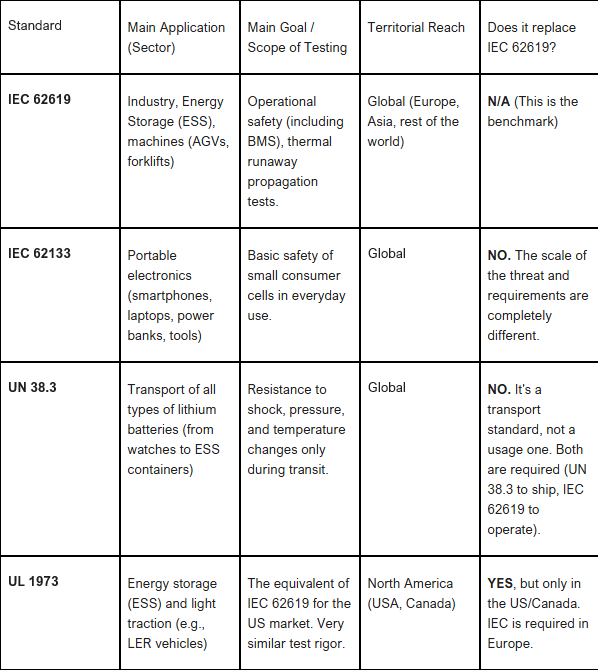
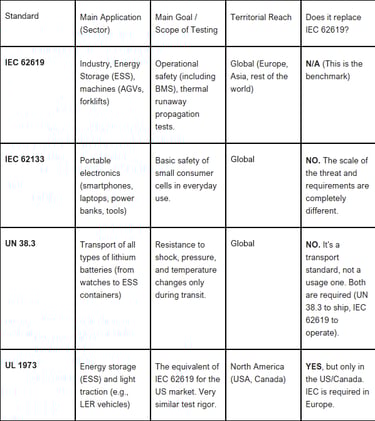
To make navigating the maze of regulations easier, we have prepared a clear overview of the most important standards on the battery market:
Comparison of battery standards vs. IEC 62619
Important!
The transport myth (UN 38.3): Many beginner importers believe that the UN 38.3 certificate resolves the safety issue. This is a mistake. UN 38.3 only guarantees that the battery will not catch fire in the cargo hold of an airplane or on a ship due to pressure differences or vibrations. It says absolutely nothing about how the battery will behave during years of intensive work in an energy storage system connected to an inverter. An industrial battery needs UN 38.3 to reach you, and IEC 62619 so you can use it safely.
American vs. European Standard (UL 1973 vs IEC 62619): If you plan to export your energy storage to the United States, the local building authorities and fire department will ask for a UL 1973 certificate (and often the related UL 9540A fire test). If you sell in Europe or Asia, IEC 62619 is the standard. Because the tests in both standards largely overlap, serious cell manufacturers often dual-certify their products during a single lab session to keep doors open worldwide.
How does IEC 62619 open the door to the CE mark and European Directives?
Meeting the standard itself is one thing, but for manufacturers, importers, and system integrators, what matters most is whether the product can be legally placed on the market. In the European Union, the passport to the market is the CE mark.
It's worth correcting a common misunderstanding here: standards themselves are (theoretically) not mandatory; the law (directives and regulations) is mandatory. However, the law states generally that a product "must be safe." How do you prove to officials or market surveillance that your two-ton energy storage system is safe? Precisely by meeting a rigorous standard like IEC 62619. This provides a so-called presumption of conformity with key directives.
Here are the legal regulations this standard is inextricably linked to:
CE Marking and the Low Voltage Directive (LVD – 2014/35/EU): For stationary energy storage systems (ESS) and large uninterruptible power supplies (UPS) connected to the power grid, the main legal act defining electrical safety is the Low Voltage Directive (LVD). To legally affix the CE mark to such a system and issue a Declaration of Conformity (DoC), the manufacturer must prove they have eliminated the risk of electric shock, fire, and thermal damage. The Test Report and IEC 62619 certificate for the batteries used form the absolute foundation for meeting the requirements of this directive.
Machinery Directive (2006/42/EC) / New Machinery Regulation: If we are powering mobile applications, such as automated forklifts, AGV platforms, or factory robots, we enter the realm of machinery law. An industrial battery is treated as a key component of the machine. According to these regulations, a potential power failure (e.g., a sudden power cut-off by the BMS) must not pose a threat to people (e.g., a forklift dropping its load). IEC 62619 certification, which places huge emphasis on functional safety and the reliability of the battery management system, gives machine designers the confidence that their equipment will pass an audit and comply with EU law.
New EU Battery Regulation (2023/1542): This is an absolute legal revolution that has entered into force and is gradually imposing new obligations on the industry. The new EU regulation categorizes batteries very precisely, distinguishing between industrial batteries and stationary battery energy storage systems, among others. This regulation introduces rigorous, hard safety requirements (listed in Annex V to the regulation) for stationary energy storage systems. EU law explicitly requires proof that these systems are safe during normal use as well as under reasonably foreseeable misuse conditions. The tests defined in the IEC 62619 standard (including the critical thermal runaway propagation test) are currently the best and most market-recognized tool for meeting the letter of this powerful new legal act.
To summarize from a legal perspective: A lack of IEC 62619 certification for an industrial battery is a massive risk. In the event of a market surveillance inspection, a fire, or a workplace accident, a manufacturer or importer without this certificate has no hard proof that they exercised due diligence when introducing the equipment to the European market.
Your passport to the market and guarantee of safety
Designing, manufacturing, or importing a large-scale ESS energy storage system or an industrial traction battery is a massive engineering and business undertaking. As we have shown in this article, in the era of energy transformation and the growing role of critical infrastructure, there is no room for experimenting with safety.
The IEC 62619 standard is more than just another certificate for the collection. It is:
Technological proof of product maturity: Confirmation that your BMS battery management system can predict and prevent a failure, and ultimately stop a catastrophic thermal runaway (propagation tests).
A legal foundation: An essential element of technical documentation allowing for the legal application of the CE mark and meeting the rigorous requirements of the New EU Battery Regulation, the Low Voltage Directive, or the Machinery Directive.
A bargaining chip in business: An argument for investors, facility insurers, and fire departments, proving that your product will not burn down their investment.
Relying on inadequate standards (like the consumer IEC 62133) or settling solely for a transport certificate (UN 38.3) is a mistake that could cost a company millions, lead to goods being blocked at the border, or cause a massive PR crisis in the event of a fire.
Are you designing an energy storage system? Are you importing industrial batteries? Don't risk it.
Understanding the complexities of the standards and preparing a battery for grueling laboratory tests is a process that requires specialized knowledge. However, you don't have to go through it alone.
The experts at battery-certyfication.com are ready to help you at every stage:
Consulting at the design stage (R&D): We will review your project and select the appropriate standards before you spend money on prototypes.
Pre-compliance (engineering tests): We will conduct preliminary tests of your cells and BMS systems to ensure they will easily pass the final propagation tests.
Comprehensive certification support: We will guide you through the entire process, from document verification through laboratory testing, to obtaining the IEC 62619 certificate and legally issuing the CE Declaration of Conformity.
Do you have questions about certifying your product? Contact us today, secure your business, and provide your customers with proven, uncompromising quality.
Copyright © 2025 DLP Sp. z o.o.